
What a Skipped Lubrication Really Costs You
Put this off for another season in Center Hill and you're not just signing up for a squeaky door. Humidity and afternoon downpours work moisture into every moving part on your garage door — hinges, rollers, the torsion spring coils, the track bolts. Dry metal grinding against dry metal wears down faster, and in this climate, unprotected steel starts to pit and rust within a season or two. That rust adds friction, which makes your opener motor work harder to lift the same door. Keep that up and you're looking at a burned-out opener, a snapped cable, or a spring that gives out months before it should. A five-minute lubrication job a couple of times a year is cheap insurance against all of that.
Tools and Supplies You'll Need
- A step ladder tall enough to reach the top of the track safely
- Clean, lint-free rags
- A stiff nylon brush (an old toothbrush works)
- Safety glasses
- A silicone-based garage door lubricant spray, or white lithium grease
- A socket wrench to check (not tighten past snug) hinge and bracket bolts
Products to Use
- Silicone-based garage door spray lubricant — thin enough to penetrate hinge pins and roller bearings, won't gum up with dust
- White lithium grease — good for heavier contact points like the spring coils, applied sparingly
Products to Avoid
- WD-40 — it's a solvent and moisture displacer, not a lubricant. It'll clean off old grime but evaporates fast and leaves parts dry again within weeks, sometimes attracting more dust in the meantime
- Standard automotive grease or axle grease — too thick for small hinge pins and roller bearings; it collects dirt and pollen instead of shedding it
- Any oil on the tracks themselves — more on that below
Step-by-Step Lubrication Guide
- Disconnect the opener and close the door manually. Pull the emergency release cord so the door is under manual control, not connected to the motor, before you start working near moving parts.
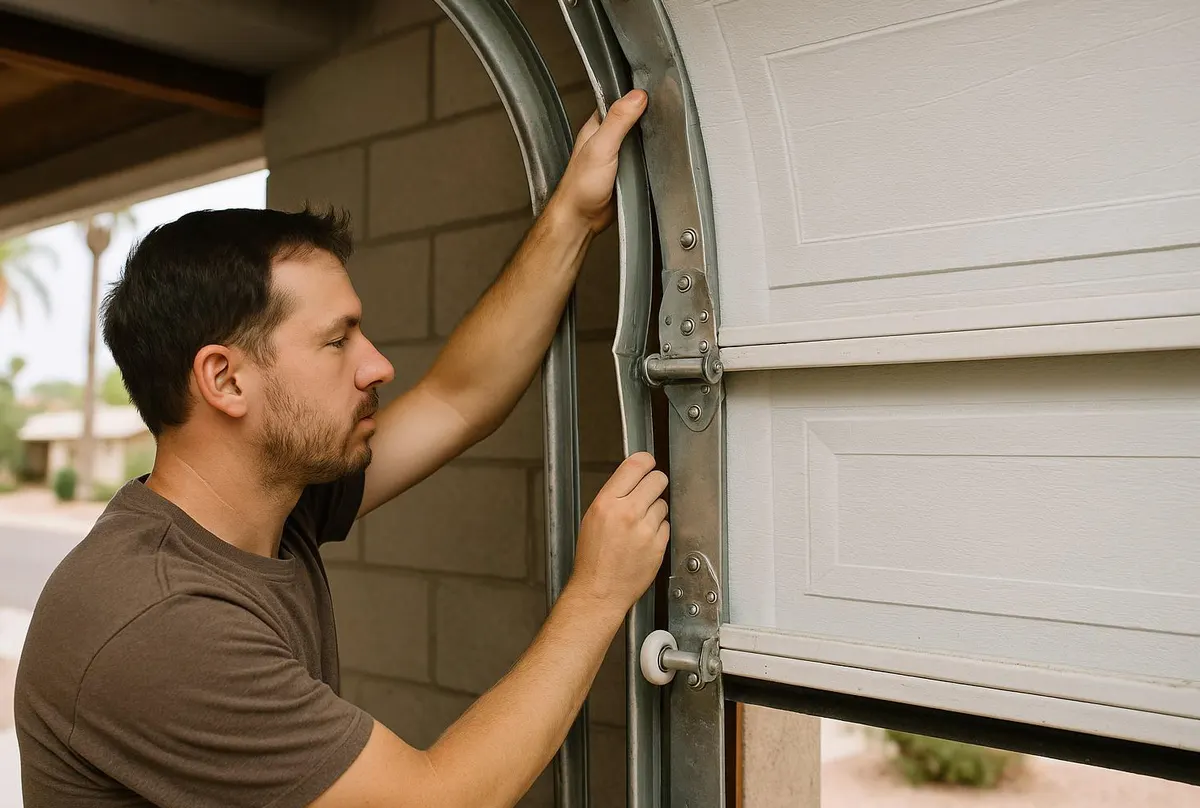
- Wipe down the tracks, rollers, and hinges with a dry rag. Salt air and storm humidity leave a fine residue on everything. Brush off caked dust or pollen with the nylon brush before adding any lubricant — spraying lubricant over grime just creates a paste that attracts more dirt.
- Lubricate the hinges. Spray a light coat of silicone lubricant directly onto each hinge pin where it pivots. Work the door up and down a few inches by hand to let it work into the joint.
- Lubricate the rollers — but only if they're steel with ball bearings. Spray the lubricant into the bearing, not the roller wheel itself. If your rollers are nylon, skip the lubricant entirely; nylon rollers are designed to run dry, and oil just attracts grit that wears them down faster.
- Leave the tracks alone. Never spray lubricant directly on the track. The rollers ride on the track's surface, and a greasy track collects dust and debris that makes rollers bind instead of roll smoothly. Clean the tracks with a rag; that's it.
- Apply a light coat of white lithium grease to the torsion spring coils. Reach this with the door fully closed. A thin coat is enough — too much grease just drips and attracts grime onto your garage floor.
- Lubricate the opener's drive mechanism. For a chain-drive opener, apply a small amount of lubricant along the chain. For a screw-drive opener, grease the threaded rail per the manufacturer's instructions.
- Check and lubricate the lock mechanism if your door has a manual lock. A quick spray keeps the latch from seizing, especially if it's rarely used.
- Wipe off excess lubricant everywhere you applied it, then reconnect the opener and run the door through a full open-close cycle, watching and listening for anything that still sticks, grinds, or sounds off.
What's a Homeowner Job, and What Isn't
Hinges, rollers, chain or screw rail, and the lock mechanism are all safe, straightforward homeowner maintenance. The torsion spring is where the line gets blurry: a light coat of grease on the coils is fine for a homeowner to apply, but the spring itself is under extreme tension and should never be adjusted, removed, or replaced without a technician. The same goes for cables — if you notice fraying, kinks, or a cable that's slipped off its drum while you're doing this routine, stop and call for help rather than trying to re-seat it yourself.
When to Call Center Hill Door & Opener
If you've gone through this routine and the door still grinds, sags on one side, or the opener strains and reverses on its own, that's past the point of lubrication. It usually means a spring has weakened, a cable is damaged, or the door has started to shift off its track — all common after a season of heavy moisture and wind-load stress on hardware. Our Garage Door Maintenance & Tune-Up service covers a full hardware inspection along with proper lubrication, and if we find a frayed cable or a spring near the end of its life, our Garage Door Cable Repair and spring replacement crews can fix it the same visit in most cases.
If your garage door is due for its seasonal check or something just doesn't sound right, call Center Hill Door & Opener. We serve Center Hill, Webster, Bushnell, Wildwood, Coleman, Sumterville, Lake Panasoffkee, and The Villages — reach out today and let's keep your door running smoothly through the season ahead.